US–India Scrap Metal Trade: Complete Playbook & Databook
A professional strategic playbook for an Indian private limited company entering international scrap metal trade — covering every viable business model from zero investment to the highest-investment plays, all required licenses, government support, institutional and political outreach, an official contact directory, a time-to-market decision filter, verified proof the model works, and a complete interactive intelligence databook of US–India scrap export/import data across all grades, types, materials, and years.
Authored byVarshini CB
Authored byRishiThej Bollam
ClassificationInternal / Confidential
Version1.0 — Sept 2026
Prepared for strategic analysis and internal decision-making. Trade figures are best-available public data (OEC / UN Comtrade / USGS / DGFT / World Steel); verify against primary sources before any commercial commitment.
Executive Overview
Why the US–India scrap metal corridor is one of the most commercially attractive trade lanes a new Indian company can enter, backed by structural demand, policy tailwinds, and favorable economics.
1
India = #1 global scrap importer
$12.74B
FY24-25 total scrap imports. India is the world's largest importer of metal scrap, feeding a steel industry that relies heavily on EAF/induction recycling.
2
US = India's #1 ferrous source
$1.17B / 17.2%
The US is India's largest supplier of ferrous scrap (HS 7204), and also #1 for aluminum scrap (HS 7602, $828M).
3
Structural demand growth
89.6 → 164.9 MT
India crude steel production more than doubled over 2015–2025, driving insatiable demand for affordable ferrous feed stock.
4
Zero-duty ferrous imports
0% BCD
Ferrous scrap imports are exempt from Basic Customs Duty (through March 2026), a direct cost advantage for importers.
5
Policy tailwind
₹1,500 Cr
Critical Mineral Recycling Incentive (FY26–31) with a 20% capex subsidy, plus a National Critical Minerals Mission.
6
Trade corridor gap
$2.3B lane
No one owns the US-to-India scrap trade corridor specifically — inspection, logistics, documentation, and payment rails. That is the white space.
The strategic thesis in one sentence
India must import scrap at scale, the US is its most reliable, highest-quality source, policy incentives favor recycling, and the specialized trade infrastructure connecting the two is underbuilt — which is exactly where a new Indian private limited company can create margin.
Live Trade Data
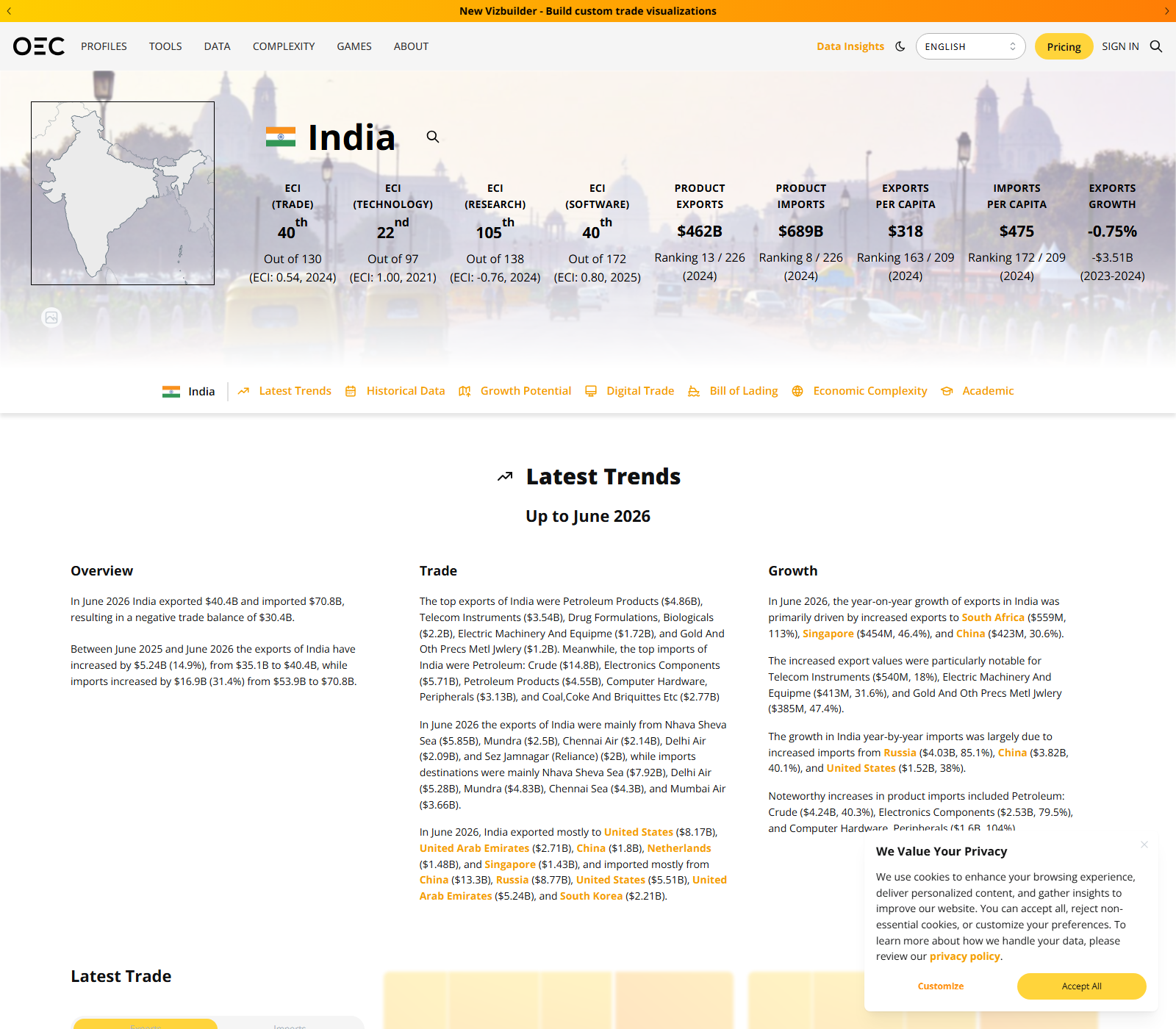
Real-time and latest-month figures captured directly from the Observatory of Economic Complexity (OEC) India profile, June 2026 vintage. Live scrapers are wired to the data tables below and refreshable.
G
Monthly Exports (Jun 2026)
$40.4B
Up 14.9% YoY (+$5.24B) from $35.1B.
G
Monthly Imports (Jun 2026)
$70.8B
Up 31.4% YoY (+$16.9B) from $53.9B.
D
Trade Balance
−$30.4B
Negative balance in June 2026 — the US benefits from India's import appetite.
U
Top US export partner
$8.17B
India's largest export destination in June 2026 is the United States.
U
US share of India imports
$5.51B
India imported $5.51B from the US in June 2026 (3rd largest source, behind China & Russia).
U
Product level
$1.72B
Electric machinery & equipment exports; scrap sits lower in the value matrix but is volume-linked to steel growth.
India's persistently negative trade balance and soaring import volumes across virtually every product category signal a deep, structural demand for raw materials — including ferrous and non-ferrous scrap. When crude steel production hits records, the scrap import bill follows. This is the macro backdrop that makes the corridor bankable.
Trade Flow — How a Container Moves
The complete physical and documentary chain from a US scrap yard to an Indian mill, with container economics.
US Origin
Scrap collected from auto-shredders, demolition, manufacturing, municipal recycling.
Graded and sorted at US yards (ISRI specifications).
Radiation screening & pre-shipment inspection (PSIC) at US origin.
Loaded into 20ft containers / breakbulk; trucked to US port.
Ocean Transit
Ocean bill of lading (B/L), export declaration (EEI via AES).
Freight: US Gulf/East Coast to Nhava Sheva/Mundra — ~30–45 days.
Insurance, incoterms (CIF/FOB/CFR) negotiated by contract.
Real-time container tracking.
India Arrival
Customs clearance on ICEGATE; SIMS registration for steel (60–7 days pre-arrival).
Delivered to Indian mill/foundry inventory (CIF + inland).
Container Economics (Ferrous)
Item
Value
Notes
Container type
20ft standard
24–26 MT per container — always weight-limited
Total landed cost
~$454/MT
Includes FOB, freight, insurance, handling, charges
Cost per container
~$11,350
24–26 MT × $454/MT
Ferrous margin
~$15/MT
~$375 per container
Non-ferrous margin
$100–400/MT
Copper/aluminum containers far more profitable per MT
Cash-to-cash cycle
50–60 days
Working capital locked until Indian payment clears
Where the real money is
Central scrap-economics insight: the profit is concentrated in mixed ferrous + non-ferrous containers. A single copper scrap container can yield the profit of ~25 ferrous containers. Winning traders actively blend and sort to maximize non-ferrous content per shipment while still moving ferrous volume for cash flow.
Key Market Players
The buyers, suppliers, and processors that define the corridor.
Company
Role
Scale / Note
JSW Steel
Buyer (EAF/BOF)
India's largest steelmaker; major scrap buyer via long-term imports.
Tata Steel
Buyer
Large integrated producer; imports metallics including scrap.
Largest US steel recycler; major ferrous scrap generator/consolidator.
SteelBro USA
US export consolidator
Mid-sized US scrap exporter active in Indian trade.
Eagle Transport / Sea-Link / Greenland America
US scrap brokers/logistics
US-side aggregation and shipment executives.
SIMS Metal Management, Radius Recycling, CMC, Steel Dynamics
US shredders/mills
Large US recyclers and mill buyers; indirect suppliers.
What a new entrant must decide
You will face two client universes: (1) US yards/consolidators who want reliable, well-documented buyers, and (2) Indian mills/foundries who want consistent, quality-graded, correctly-documented scrap at a landed price below local alternatives. Winning either requires solving the documentation-and-trust problem — exactly the gap a trade company exists to close.
India Import Intelligence
India's scrap import position by material, with US share — the demand anchor for the corridor.
Complete intelligence on US–India scrap export/import: every major grade, type, material, and year with multi-select sorting filters. Use the filters below to slice the full chain — by material, grade, HS code, or sourcing region. Rows update live.
Showing all rows.
Material
Grade / Type
ISRI Code
HS Code
Description / Purity
2026 Price Range
Origin Region
Primary Dest. Metros
Data Visualization & Interactive Charts
Year-wise trade volumes, prices, and market structure as interactive charts. Hover for exact values. Series sourced from USGS, UN Comtrade, World Steel, and Fastmarkets.
India ferrous scrap imports (HS 7204) by year. Source: UN Comtrade / TrendEconomy. 2024-26 est.
India aluminum scrap imports (HS 7602) by year. Source: UN Comtrade.
India copper scrap imports (HS 7404) by year. Source: UN Comtrade.
US ferrous scrap exports to India (thousand MT). Source: USGS / US Census.
India crude steel production (MT) — the key scrap demand driver. Source: World Steel.
US Scrap Export Value & Volume
Total US ferrous scrap (HS 7204) export value, $B. Source: US Census.
US scrap export volume to India by ferrous/non-ferrous (million MT).
Business Model Analysis
Four primary models, ranked by speed to revenue, with full economics. A smart company sequences these rather than picking one — trade first for cash flow, then inspection, then platform, then finance.
1
Model 1: Scrap Aggregation & Trading
$400K–6M/yr
Time to revenue: 3–6 months Startup cost: ₹25–50 lakh Margin: $30–80/MT ferrous, $200–500/MT non-ferrous How: Buy from 50+ small US yards, consolidate into containers, export to Indian buyers.
2
Model 2: Inspection & QA Service
$360K–1.8M/yr
Time to revenue: 4–8 months Startup cost: ₹30–60 lakh Margin: $200–500 per inspection How: AI-based quality grading, radiation testing, PSIC issuance at US origin.
3
Model 3: B2B Trade Platform
$600K–2.4M/yr
Time to revenue: 6–12 months Startup cost: ₹15–30 lakh Margin: 1–3% transaction fee + subscriptions How: Digital marketplace connecting US exporters with Indian importers.
4
Model 4: FX / Trade Finance Fintech
$900K–3.6M/yr
Time to revenue: 8–14 months Startup cost: ₹10–15 Cr (capital intensive) Margin: 0.5–1.5% FX spread + 12–18% APR How: Escrow, FX hedging, working capital for scrap trade.
Revenue vs Startup Cost by Model
Why trade-first is the recommended entry
The trading model generates cash from the first shipment, requires no heavy licensing, and builds the exact relationships, data, and documentation muscle that a subsequent inspection business, B2B platform, and finance arm all depend on. Every other model is easier to build after you have live trade running.
The Complete Playbook
Every viable business model for an Indian private limited company in US-India scrap trade — from zero/low investment up to the highest-investment plays — with licenses, government support, and a time-to-market decision filter.
A. Time-to-Market Decision Filter
Use this to pick where to start. Low time-to-revenue and low capital are the fastest validators for a new entrant.
Model
Capital Needed
Time to First Revenue
Time to Scale
Risk
Recommendation
A. Trade Desk / Broker (agency)
~₹2–8 lakh
2–4 weeks
3–6 months
Low (no inventory)
START Fastest validation
B. Scrap Aggregation & Trading (inventory)
₹25–50 lakh
3–6 months
6–12 months
Medium
CORE
C. Inspection / QA / PSIC
₹30–60 lakh
4–8 months
12 months
Low (regulatory moat)
ADD High margin
D. B2B Marketplace
₹15–30 lakh
6–12 months
12–24 months
Medium (chicken-egg)
NEXT
E. FX / Trade Finance
₹8–15 Cr
8–14 months + RBI
18+ months
High (licensing)
LATER Capital heavy
F. Recycling Plant / Yard
₹5 Cr+
12–24 months
2–3 years
High (CAPEX)
LATER Needs subsidy
B. Full Model Menu (low → high investment)
Model A — Zero/Low-Investment Trade Desk & Brokerage
Capital: ~₹2–8 lakh. Time to revenue: 2–4 weeks. How: You act as a commissioned agent matching US exporters to Indian importers without taking inventory. Earn 0.5–2% commission per matched container on a finder-fee or per-shipment basis. No stock, no customs risk, minimal working capital.
Licenses: Company incorporation, IEC (DGFT), GST.
Proof: Brokerage is how most successful scrap traders start; it validates demand before risking capital. Commission-only removes price risk entirely.
Time-to-market: Fastest possible. Register, get IEC, list on B2B platforms, call importers.
Model B — Scrap Aggregation & Trading (Core)
Capital: ₹25–50 lakh. Time to revenue: 3–6 months. How: Buy from 50+ US yards, consolidate into containers, export CIF to Indian buyers. Margin $30–80/MT ferrous, $200–500/MT non-ferrous.
Full economics (Model 1 deep-dive, see SCRAP-EXPORT-DEEP-DIVE.md): total landed cost ~$454/MT; ~$11,350 per 20ft container; ferrous margin ~$15/MT ($375/container); non-ferrous $100–400/MT; Year-1 net loss ~$73,575 with breakeven around month 15; cash-to-cash 50–60 days; working capital $33.6K–100.8K.
Model C — Inspection, QA & PSIC Service
Capital: ₹30–60 lakh. Time to revenue: 4–8 months. How: Firm of third-party inspection / QA & analysis (FITI) at US origin: AI-based quality grading, radiation testing, and PSIC issuance required for Indian customs. $200–500/inspection, recurring and asset-light with a regulatory moat (DGFT PSIA approval).
Model D — B2B Cross-Border Marketplace
Capital: ₹15–30 lakh. Time to revenue: 6–12 months. How: Digital marketplace connecting US exporters to Indian importers. Revenue = 1–3% take-rate + subscriptions + value-added services (inspection, logistics, documentation, escrow). Comparables: MetalMandi/Attero, ScrapMitra, Buddy (tradebuddy.io), MetalBook, Reibus, ScrapAdvisor, ScrapMonster. Key challenge is the classic chicken-and-egg of two-sided markets — solved by launching on top of your own live trading volumes.
Model E — FX / Trade Finance Fintech
Capital: ₹8–15 Cr. Time to revenue: 8–14 months + RBI licensing. How: Escrow, FX hedging, and working-capital finance for the scrap trade. FX spread 0.5–1.5%; loan/SCF APR 12–18%. Direct payment/PA/PG licensing requires ≈₹25 Cr net worth, so the realistic path is to partner with TReDS, an IFSCA platform, or a GIFT City (M1 NXT) entity rather than build standalone. USD/INR forward hedging costs ~1.5–3% annually.
Model F — Recycling Plant / Yard (Highest Investment)
Capital: ₹5 Cr+. Time to revenue: 12–24 months. How: Own shredding / processing plant or yard, adding domestic value to imported and local scrap. This is where the ₹1,500 Cr Critical Mineral Recycling incentive (20% capex subsidy) and the PLI for specialty steel become relevant. Highest capex, highest long-term margin, but slowest payback.
C. Recommended Sequencing (low risk → scale)
Phase 1 (Months 1–3)
Trade Desk + First Containers
Incorporate, IEC, GST. Start brokerage, then 2–3 trial containers. Validate demand and documentation.
Phase 2 (Months 3–9)
Scale Trading + Add Inspection
Grow to 5–10 containers/month. Apply for PSIA approval and launch inspection/QA for other importers.
Phase 3 (Months 9–18)
Platform + Government Funding
Launch B2B marketplace on live volumes. Apply for ₹1,500 Cr recycling incentive, Seed Fund, CGSS guarantees.
Phase 4 (Months 18+)
Finance + Plant
Add escrow/FX via GIFT City/TReDS partnership. Consider a recycling plant once volume justifies CAPEX.
Licenses & Compliance Required
The complete list an Indian private limited company needs to legally trade scrap internationally. Official costs and timelines indicated; verify current rates with the issuing authority.
India-Side Requirements
Requirement
Authority
Cost
Timeline
IEC (Importer Exporter Code)
DGFT
₹500 (~$6)
1–5 days
Company Incorporation (Pvt Ltd)
MCA
₹15,000–25,000
7–15 days
DGFT Import License (restricted items)
DGFT
₹10,000–25,000
30–60 days
PSIC (Pre-Shipment Inspection)
DGFT-approved PSIA
₹5,000–15,000/shipment
Per shipment
MoEFCC Authorization
Min. of Environment
₹25,000–1,00,000
30–90 days
SPCB Registration
State Pollution Board
₹10,000–50,000
30–60 days
SIMS Registration (Steel)
Min. of Steel
Free
60–7 days before arrival
GST Registration
GSTN
Free
7–15 days
CPCB Authorization (hazardous)
Central Pollution Board
Varies
30–90 days
BIS Certification
Bureau of Indian Standards
₹25,000–1,00,000
90–180 days
US-Side Requirements
Requirement
Authority
Notes
FMC License
Federal Maritime Commission
If operating as NVOCC / shipping agent
EPA Registration
US EPA
If handling hazardous materials
State Scrap Dealer License
State govt (varies)
Required in most states for collection
ISRI Membership
Institute of Scrap Recycling Industries
Recommended for credibility
BIR Membership
Bureau of International Recycling
Global industry body
DOT Compliance
Dept. of Transportation
For inland transport of scrap
OSHA Compliance
Occupational Safety
Workplace safety at yards
BSA / AML
FinCEN
Cash transaction reporting >$10K
Import Duty Structure (India)
G
Ferrous Scrap
0% BCD
BCD exempt since 2021 Budget, extended through March 2026. SWS 0%, IGST 18% (reclaimable ITC).
D
Copper Scrap
2.5% BCD
Reduced from 5% in 2021. SWS 0.25%, IGST 18%. 2027 rule: 25% must stay domestic.
D
Aluminum Scrap
2.5% BCD
Industry lobbying for 15% uniform (AAI). Current rate favors importers. IGST 18%.
G
Lead / Zinc / Nickel
0–2.5%
Generally low. Critical mineral classification (2023-24) adds policy tailwind for imports.
Government Support & Funding
Every scheme, incentive, and grant available to a startup in the scrap/recycling/trade space.
Scheme
Ministry
Benefit
Amount
Eligibility
Link
Startup India (DPIIT Recognition)
DPIIT
Tax holiday, IP rebates, self-certification, govt procurement exemption
Who to approach and how — verified official institutions, ministries, industry associations, and trade-delegation channels. These are "who to talk to" pathways, not fabricated personal phone numbers.
The correct, non-fabricated way to get institutional and political attention: (1) respond to public Draft Policy / DGFT public notices with written representations; (2) join FICCI/CII delegation trips to the US and industry sessions; (3) engage export promotion councils for market access support; (4) use the India-US Trade Policy Forum (TPF) and Bilateral Trade Agreement (BTA) consultations to flag scrap-trade barriers; and (5) apply for Steel PLI / Critical Mineral Recycling incentive which formally routes you to the relevant ministry desks.
4. State Industrial Corporations
Corporation
State
Relevance (scrap processing hubs)
GIDC
Gujarat
Mundra/Jamnagar recycling & foundry clusters
MIDC
Maharashtra
Nhava Sheva port-adjacent industrial land
APIIC
Andhra Pradesh
Visakhapatnam port & metal parks
Official Contact Directory
Verified official contacts for execution — licensing agencies, inspection bodies, ports, buyer associations, and US counterparts. Always dial the verification/first-contact numbers and confirm current details before relying on them.
These are verified official switchboard/helpline channels compiled from CONTACT_DIRECTORY.md. Always call the primary number to confirm the correct desk, extension, or email before relying on them. We deliberately do not list personal mobile numbers or individual politicians.
Regulatory Landscape & Recent Policy
The timeline of policy that shapes the corridor — and keeps it favorable to importers.
Feb 2026
US-India Interim Trade Framework
US replaced 25% IEEPA duty with 18% reciprocal tariff. Scrap not directly impacted (US exports scrap). Source
Jun 2025
Section 232: 50% Tariff on US Steel/Aluminum Imports
Does not tax US scrap exports; actually supports domestic scrap supply by limiting steel imports. CRS Report
Jun 2025
SIMS Registration Window Updated
Steel importers register 60–7 days before vessel arrival; authorization valid 75 days. SIMS Portal
MetalMandi owns domestic Indian scrap pricing. ScrapMitra handles domestic B2B auctions. Buddy targets global recycling trade. But nobody owns the US-to-India scrap trade corridor specifically — the inspection, logistics, documentation, and payment rails for this $2.3B bilateral flow. That is the white space.
Implementation Roadmap
The hybrid model: start with trading, add inspection, then build the platform.
Visit/call 50+ small US yards (Virginia, Seattle, Chicago) → negotiate pricing → set up trucking-to-port → establish PSIC with a DGFT-approved inspection agency at US origin.
Month 3–4: Indian Buyers
Secure Offtake
Connect with 10+ Indian buyers (Gujarat, Maharashtra, Tamil Nadu) → CIF terms → LC/escrow → SIMS registration for steel.
Month 4–6: First Shipment
Launch Trading
First container/breakbulk → 25–30 MT ferrous @ $40/MT margin ≈ $1,000–1,200 profit → scale to 5–10 containers/month → $5K–12K/month revenue.
Month 6–9: Add Inspection
Launch QA
Apply for DGFT PSIA approval → AI grading → offer inspection to other importers → $200–500/container → +$5K–15K/month.
Month 9–12: Platform MVP
Build B2B Marketplace
Use trading data → onboard 50+ US suppliers, 20+ Indian buyers → 1–2% transaction fees → raise seed round on traction.
Month 12–18: Scale
Growth & Funding
Apply for ₹1,500 Cr recycling incentive + Seed Fund → scale to 50 containers/month → add FX/escrow → revenue target ₹5–10 Cr/year.
Total investment needed: ₹25–50 lakh ($3K–6K)
Enough to incorporate, license, ship 2–3 trial containers, and build an MVP. Trading generates cash from month 4–5, making the venture largely self-funding after initial capitalization.
Sources & References
Every data point in this report is sourced and linked.